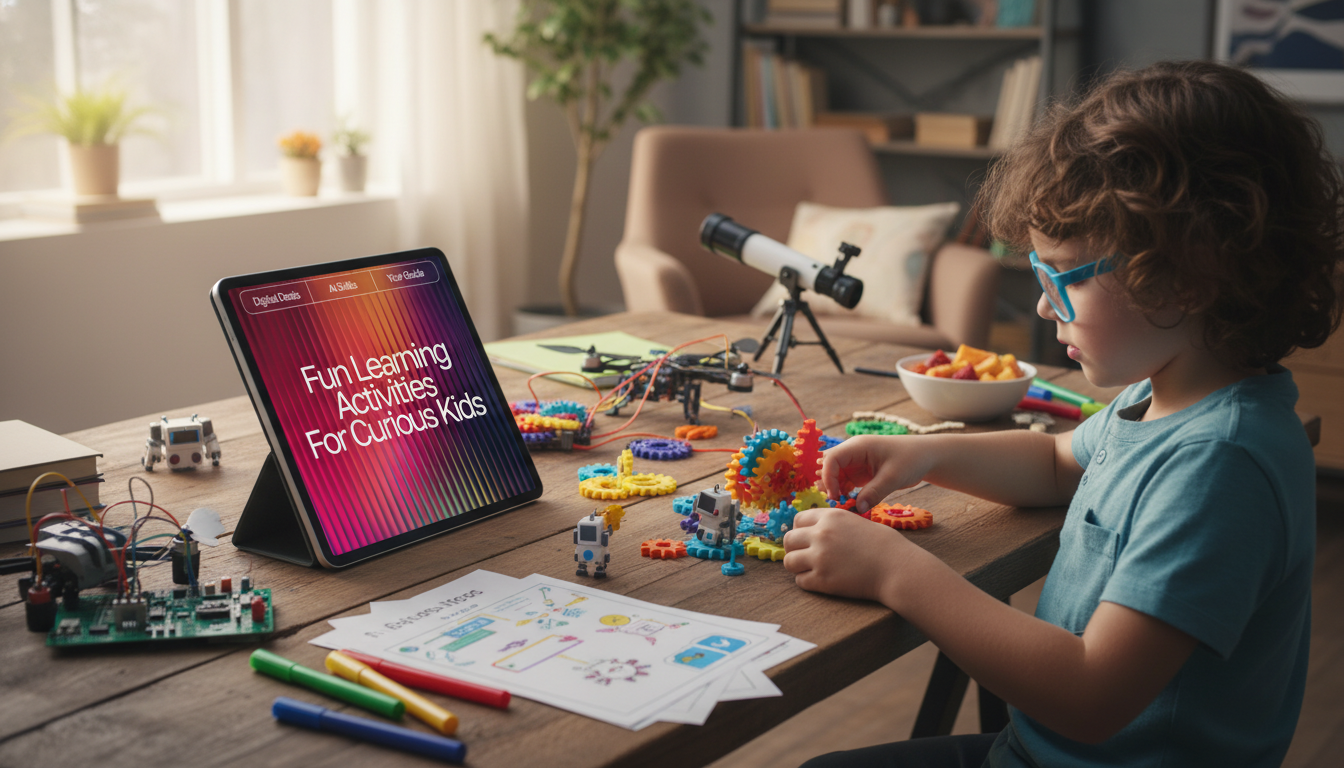
Kids are already surrounded by smart tools—voice assistants, recommendations, and image generators. AI Adventures: Fun Learning Activities for Curious Kids (Digital eBook) turns that curiosity into hands-on, screen-smart activities that build creativity, problem-solving, and STEM thinking through play. It’s designed to help families and educators introduce AI ideas in a kid-friendly way while encouraging safe, responsible tech habits. For more guidance, see New education books: New print books – Guides – Stanford University.
When AI feels like “magic,” it can be exciting—but also confusing. The best early AI learning keeps things practical, playful, and honest about what these tools can (and can’t) do. For further reading, see Digital Device Usage and Childhood Cognitive Development – PMC.
For a bigger-picture look at children’s rights and safety around AI, UNICEF’s guidance is a strong reference point: UNICEF Policy Guidance on AI for Children.
AI Adventures is built around guided activities that blend creativity with STEM-style thinking. The flow is intentionally simple: pick an activity, try it, talk about what happened, then level it up. That rhythm helps kids see that improving a system (or an idea) is normal—and that “wrong” results can be useful clues.
| Activity style | Great for practicing | Typical time | Adult help level |
|---|---|---|---|
| Story-based challenges | Creative thinking, cause-and-effect, explaining decisions | 15–30 minutes | Low–Medium |
| Hands-on games & puzzles | Pattern recognition, logic, iteration | 10–25 minutes | Low |
| Mini experiments | Testing predictions, noticing bias, keeping simple notes | 20–40 minutes | Medium |
| Make-and-improve projects | Design thinking, feedback loops, problem-solving | 30–60 minutes | Medium–High |
You don’t need a lab or a complicated setup to explore AI concepts. A few household objects, some paper, and a willingness to test-and-tweak can go a long way.
For educators exploring classroom-friendly approaches and considerations, ISTE’s overview is a helpful companion resource: ISTE: Artificial Intelligence in Education.
AI-themed play can quietly strengthen “real-world” thinking skills kids use across subjects—reading, science, art, and even conflict resolution (because collaboration always brings big feelings).
Curiosity and caution can go together. Simple guardrails help kids experiment with confidence while building habits that matter long after the activity ends.
For practical, age-aware guidance on AI and digital life, Common Sense Media offers useful educator resources: Common Sense Media: Artificial Intelligence.
It’s a great fit for elementary-age kids through early middle school. Younger kids can do most activities with adult help, while older kids can extend challenges by adding deeper questions, tracking results, or debating fairness and accuracy.
No—many activities are unplugged or low-tech and focus on core ideas like patterns, predictions, and mistakes. Coding can be a fun bonus, but it isn’t required to understand or enjoy the activities.
Many activities fit into 10–30 minutes, with optional “level up” steps that can extend learning to 45–60 minutes. That flexibility works well for classroom periods, clubs, or after-school play.












Leave a comment