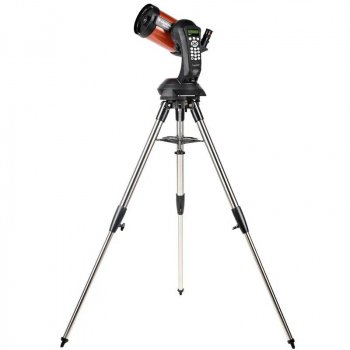
A 125mm Schmidt-Cassegrain paired with a computerized GoTo mount and StarBright XLT coatings is built for efficient observing: a compact tube, a long focal length for detail, and assisted pointing so more of the session happens at the eyepiece. Night one is usually less about chasing faint fuzzies and more about dialing in power, alignment, and focus—then letting the telescope’s tracking keep targets steady while you learn what your skies support.
This style of 125mm (5-inch) SCT is a strong all-around choice for observers who want guided object locating without hauling a bulky optical tube. The long F/10 focal ratio naturally leans toward higher magnifications, and it’s generally forgiving with many common eyepieces.
The experience through a 125mm SCT is shaped by two big factors: aperture (how much light and resolution you have) and focal length (how narrow the view is at a given eyepiece focal length). StarBright XLT coatings are intended to boost overall transmission, which can help views look a bit brighter and higher-contrast—especially when the target is already near the threshold of what your sky allows.
| Spec | Value | Why it matters |
|---|---|---|
| Aperture | 125mm | Controls brightness and resolving power; supports detailed lunar/planetary viewing |
| Focal ratio | F/10 | Longer effective focal length; easier high magnification, narrower maximum field |
| Optical design | Schmidt-Cassegrain | Compact tube; versatile for visual use and imaging with accessories |
| Mount feature | Computerized GoTo | Automated pointing/tracking after alignment; improves time-to-target |
| Optical coatings | StarBright XLT | Enhanced transmission for improved contrast and brightness on many objects |
For a deeper overview of what enhanced coatings are designed to do, see the manufacturer’s explanation of StarBright XLT coatings. If you’re still building your foundation around magnification, field of view, and what to expect by aperture, Sky & Telescope’s telescope basics is a helpful reference.
Night-one success is mostly about preventing small issues (power drops, rushed alignment, thermal blur) from stacking together. A smooth routine makes GoTo feel “magical” instead of finicky.
| Step | What to do | Common pitfall to avoid |
|---|---|---|
| 1. Site selection | Pick a spot with a clear view of the sky and minimal vibrations | Setting up on a deck that flexes while walking |
| 2. Power | Confirm stable power before turning on | Voltage drops causing alignment failures or runaway slews |
| 3. Cooldown | Wait 20–60 minutes depending on temperature difference | Chasing focus while the scope is still thermally settling |
| 4. Alignment | Use accurate time/location and careful centering | Rushing star centering or picking stars too close together |
| 5. First target | Start with the Moon or a bright planet to confirm focus and tracking | Jumping to faint objects before verifying everything works |
Two practical tips that save time: (1) start centering alignment stars at low power, then swap to higher power for final centering; (2) manage cables so nothing snags during a long slew across the sky. If you’re new to planning what to observe, NASA’s beginner-friendly skywatching guidance can help you pick “high-confidence” targets for early sessions.
A 125mm telescope can deliver crisp, high-contrast views on bright targets and satisfying deep-sky performance on the showpieces—especially from a darker site. Under suburban lighting, the telescope still performs well, but the sky background is brighter, so faint galaxies and nebulosity lose contrast quickly.
| Use case | Typical magnification range | Notes |
|---|---|---|
| Finding and framing objects | 40×–80× | Wider view makes centering easier and reduces shakiness |
| General viewing | 80×–150× | Often the sweet spot for many objects |
| Planetary and lunar detail | 150×–250× (seeing-dependent) | Higher powers only work well under steady skies |
| Double stars | 150×–300× (target-dependent) | Best results require precise focus and stable air |
Alignment is usually straightforward after a couple of sessions: enter accurate time/location, choose two (or more) bright stars far apart, and center them carefully. Start with low power to get close, then switch to higher power for precision, and make sure your power source is stable.
Yes for planets and the Moon: 125mm can show crisp lunar detail and meaningful planetary features when the atmosphere is steady. For deep-sky objects, it performs best on brighter clusters and nebulae, while faint galaxies and subtle nebulosity improve dramatically under darker skies.
Enhanced coatings typically help in a cumulative way by improving transmission and perceived contrast across the optical path. The benefit is most noticeable on dimmer targets and overall image brightness, though sky quality and aperture remain the biggest factors.










Leave a comment